
[Modular 101] Designing for Manufacturing: Tolerances, Interfaces, and Precision
Precision Is Not Perfection
It is often assumed that factory fabrication eliminates the inconsistencies associated with traditional construction. The logic is intuitive: controlled environments, standardized processes, and repeatable assemblies should result in highly precise building components. However, this assumption is misleading. Modular construction does not eliminate tolerances; instead, it reorganizes where and how they manifest.
In conventional construction, dimensional discrepancies are absorbed gradually. Minor adjustments occur across trades, often informally, and are distributed over time. In modular construction, this flexibility is significantly reduced. Modules arrive on-site as fixed geometries, and alignment must occur at discrete connection points. The opportunity for adjustment is limited, and in many cases, constrained by structural, fire-resistance, and enclosure requirements.
Designing for modular construction, therefore, requires a shift in mindset. Precision must be actively managed, and tolerances must be understood not as errors, but as inherent conditions that must be designed for.

Sources of Tolerance in Modular Construction
Tolerances in modular construction emerge from a combination of manufacturing processes, material behaviour, transportation effects, and installation conditions. Each of these sources contributes small dimensional variations, which become significant when combined.
Within the factory, tolerances arise from fabrication methods and material properties. Even under controlled conditions, materials such as steel and wood respond to fabrication, handling, and environmental factors. Assembly processes, including fastening, welding, and sequencing, introduce additional variability. While quality control systems reduce inconsistency, they do not eliminate it.
Transportation introduces another layer of complexity. Modules are subjected to dynamic loading conditions during transit, including vibration, acceleration, and temporary support configurations. These forces can induce minor deflections or distortions, particularly in assemblies that span longer distances or rely on lightweight framing systems.
At the site level, installation conditions further contribute to dimensional variation. Foundations, while designed to tight tolerances, are rarely perfectly level or aligned. Crane placement, rigging, and sequencing can introduce small positional shifts during installation. As modules are stacked, these deviations accumulate vertically.
The critical issue is not any single source of tolerance, but the cumulative effect across multiple modules and storeys. This accumulation is what distinguishes modular construction from conventional approaches and is where most coordination challenges arise.
Stacking Logic and the Accumulation of Error
In volumetric modular construction, structural loads are transferred through stacked modules in a continuous vertical path. This requires careful alignment of bearing elements, columns, and structural frames. However, structural alignment alone does not ensure geometric alignment.
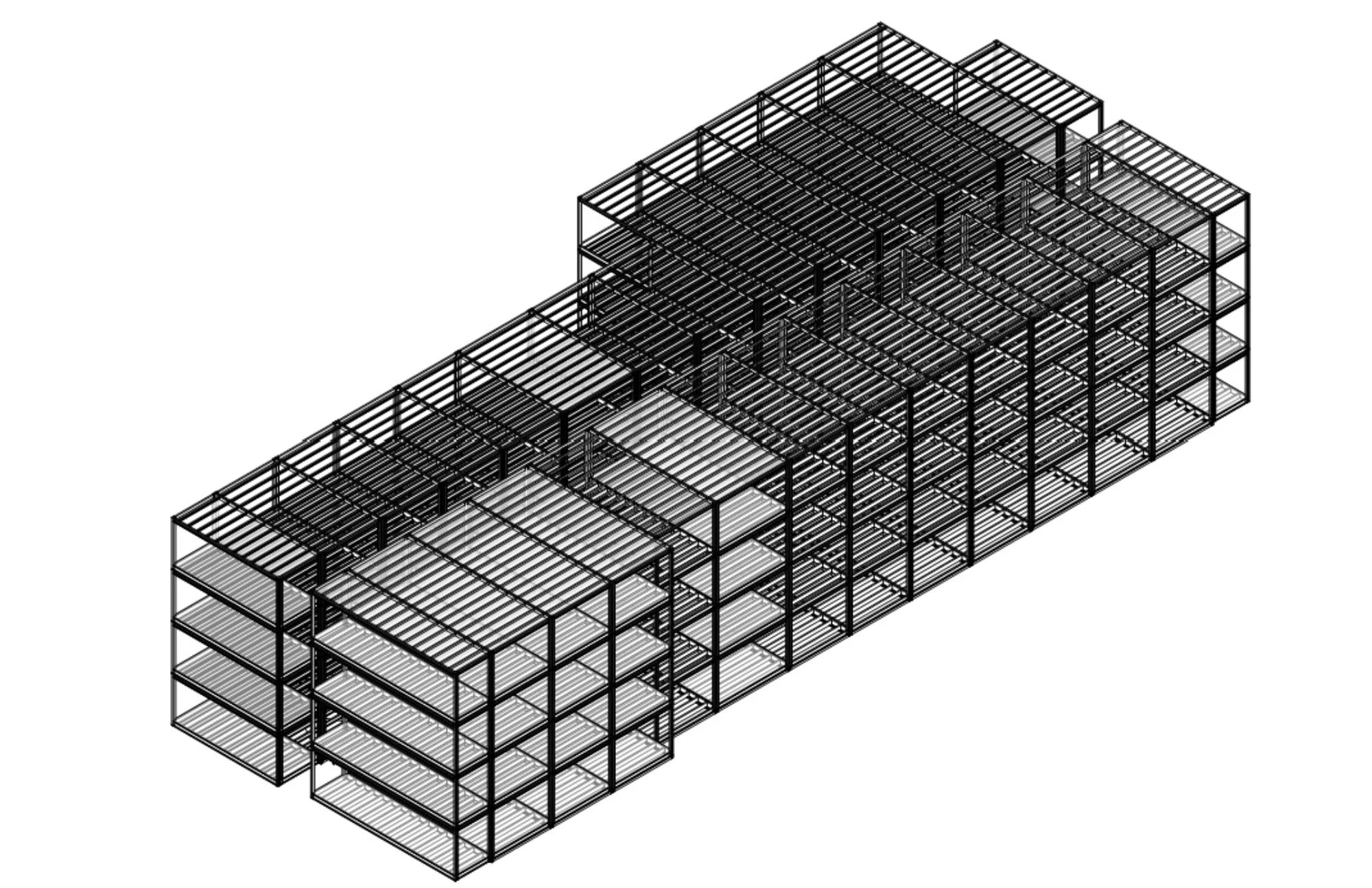
As modules are stacked, even minor deviations can result in noticeable misalignment. Corridor walls may shift slightly between floors, façade systems may not align perfectly, and service risers may become difficult to coordinate. These issues become more pronounced as building height increases.
The consequences extend beyond visual discrepancies. Misalignment can disrupt fire-resistance continuity, compromise acoustic separation, and create discontinuities in air and vapour barriers. These are not superficial concerns; they directly affect building performance and regulatory compliance.
To address this, modular design must incorporate a dual strategy. On one hand, there must be rigorous dimensional coordination to minimize variation. On the other hand, the design must include intentional zones where adjustment is possible. Without both, the system becomes either too rigid to accommodate real-world conditions or too loose to maintain performance standards.
Interfaces as Critical Points of Risk
While individual modules are often fabricated with a high degree of precision, the most complex challenges occur at the interfaces between modules and between modular and site-built elements. These interfaces are where multiple systems converge and must perform continuously across discontinuous construction processes.
At these junctions, structural loads must be transferred reliably, fire-resistance ratings must be maintained, acoustic separation must remain intact, and enclosure systems must provide continuous protection against air and moisture. Achieving all of these simultaneously requires coordination across disciplines and scopes.
In conventional construction, these systems are typically layered continuously, allowing adjustments during installation. In modular construction, much of this work is pre-completed in the factory, leaving limited opportunity for correction on-site. As a result, interfaces must be designed with a level of foresight that exceeds typical detailing practices.
A recurring failure mode in modular projects is the assumption that assemblies which perform adequately within a single module will also perform across module boundaries. Without an explicit design of the interface condition, this assumption often proves incorrect. The result is a breakdown in performance exactly where continuity is most critical.
This issue is explored further in this post, where mateline conditions are examined in greater detail.
Designing for Controlled Adjustment
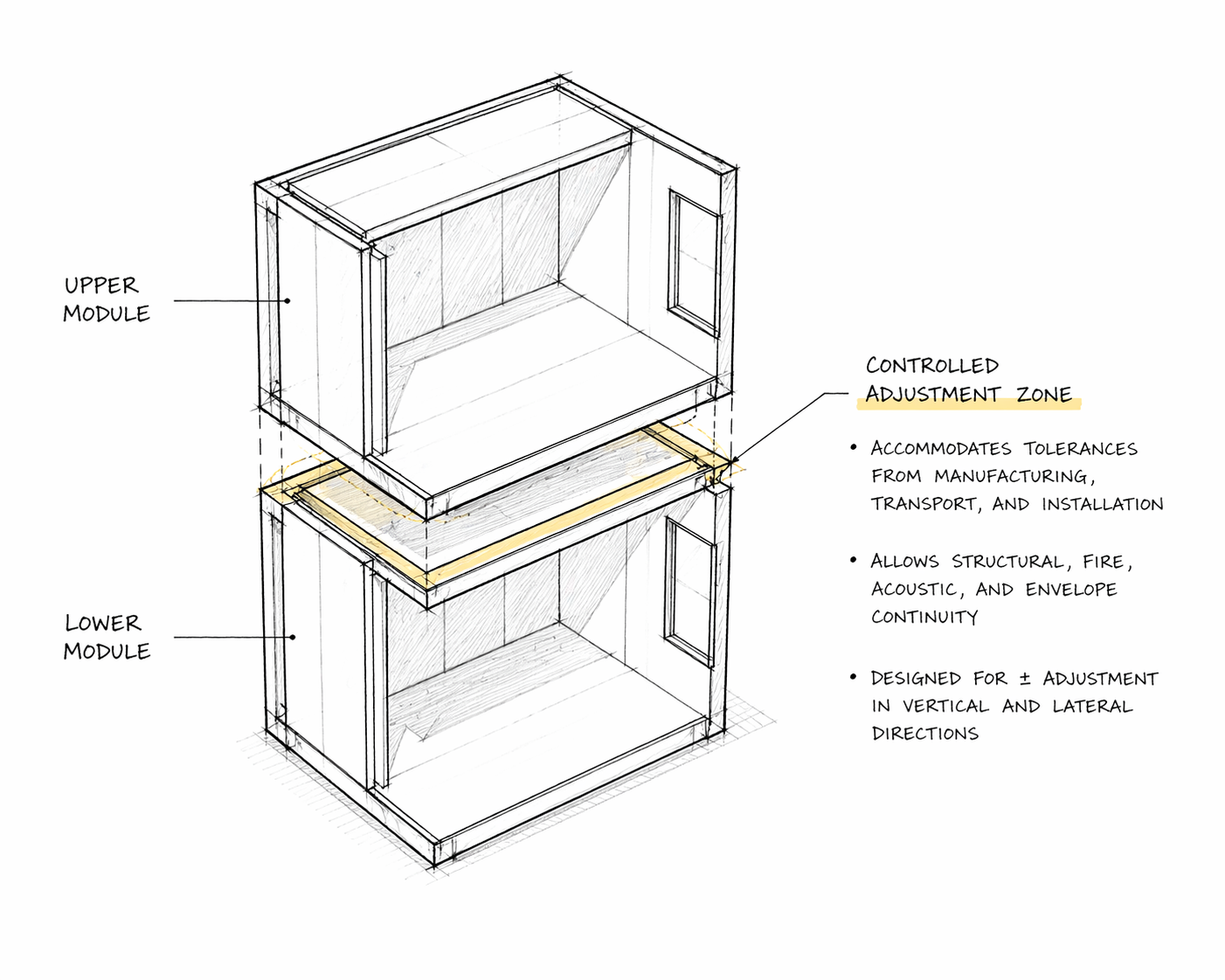
Given the inevitability of dimensional variation, successful modular design does not seek to eliminate tolerances, but to manage them. This is achieved by introducing controlled adjustment zones within the building system.
These zones are typically located at interfaces, where flexibility can be incorporated without compromising overall performance. For example, connections between modules may be designed to allow minor positional adjustments while maintaining structural integrity. Façade systems may be detailed to accommodate slight misalignments without affecting weather performance. Service connections may be designed with tolerance ranges rather than fixed points.
Such strategies require intentional design. They cannot be retrofitted late in the process without significant rework. More importantly, they require coordination between architectural, structural, and building science considerations, as adjustments in one system can affect performance in another.
The goal is not to introduce looseness into the system, but to define precisely where flexibility is permitted and where it is not.
Transportation as a Primary Design Constraint
In addition to tolerances, modular construction is shaped by transportation constraints. Unlike conventional materials, volumetric modules must be moved as large, three-dimensional objects through existing infrastructure networks.
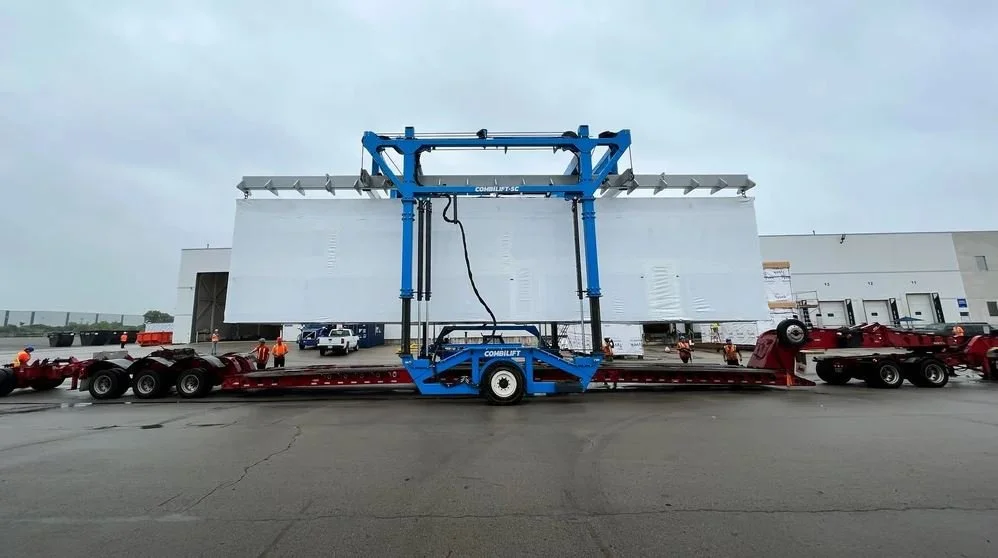
Photo Credit: Fero International
In Ontario and much of North America, transportation regulations impose limits on module width, height, and weight. These limits are not abstract; they directly influence building design. Unit dimensions, structural spans, and even building massing must be coordinated with transport feasibility.
When these constraints are not considered early, the consequences can be significant. Modules may need to be resized, structural systems redesigned, or transport strategies revised, all of which introduce cost and delay.
For reference on transportation constraints, see:
Ontario Ministry of Transportation – Oversize/Overweight Loads
https://www.ontario.ca/page/oversize-overweight-loads
Lifting Conditions and Temporary Structural Behaviour
Another often overlooked aspect of modular design is the structural behaviour of modules during lifting and installation. Modules are not only subject to loads in their final installed condition, but also to temporary forces during handling.
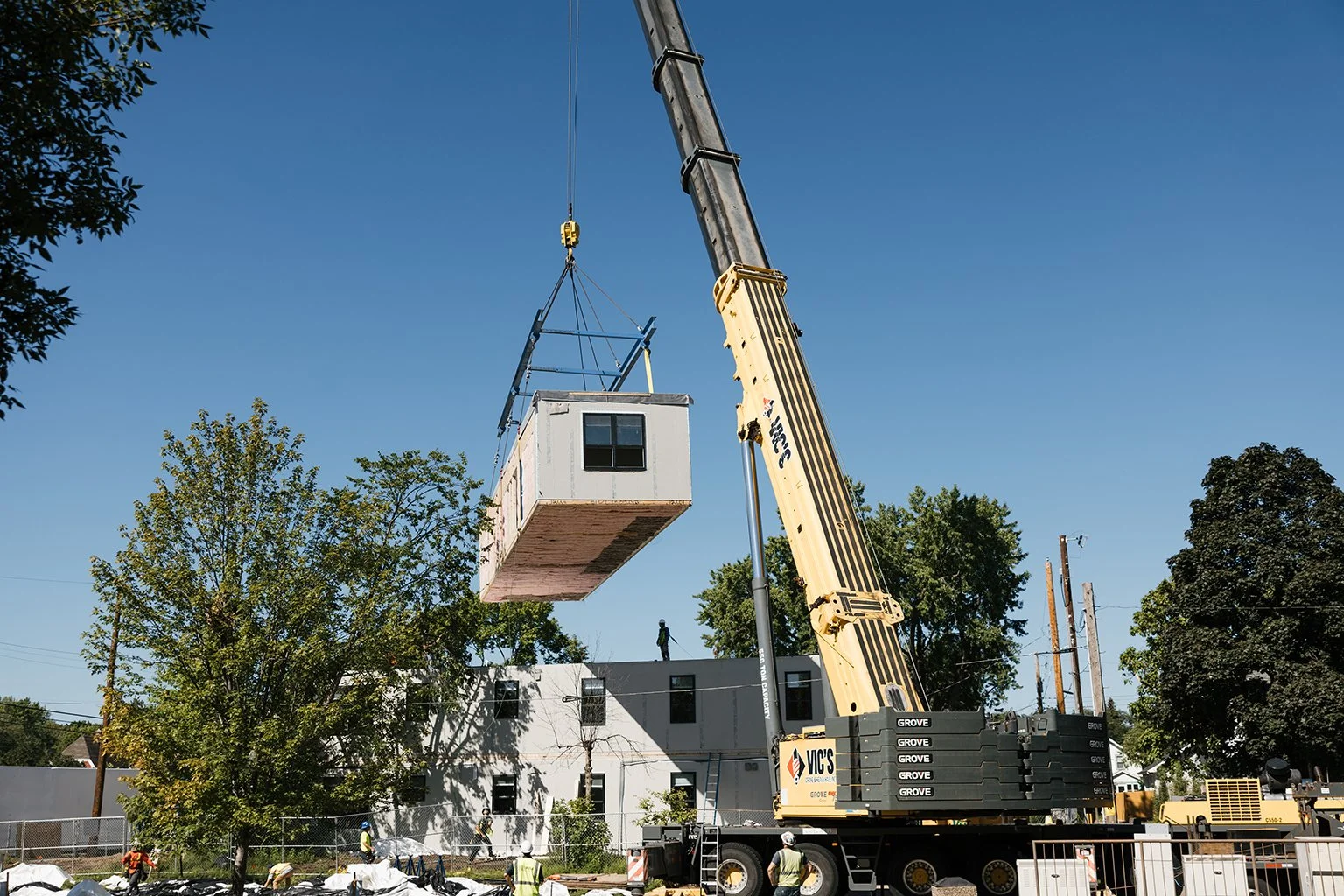
Photo Credit: Rise Modular
Lifting typically occurs at discrete points, creating stress conditions that differ from those experienced in the completed building. Structural frames must therefore be designed to accommodate both permanent and temporary load cases. Lifting points must be coordinated with architectural layouts to avoid conflicts with openings, finishes, or services.
Failure to consider these conditions early can result in structural modifications or damage during installation. As with other aspects of modular construction, these considerations must be integrated into the design process from the outset.
Applied Scenario: Tolerance Accumulation in Practice
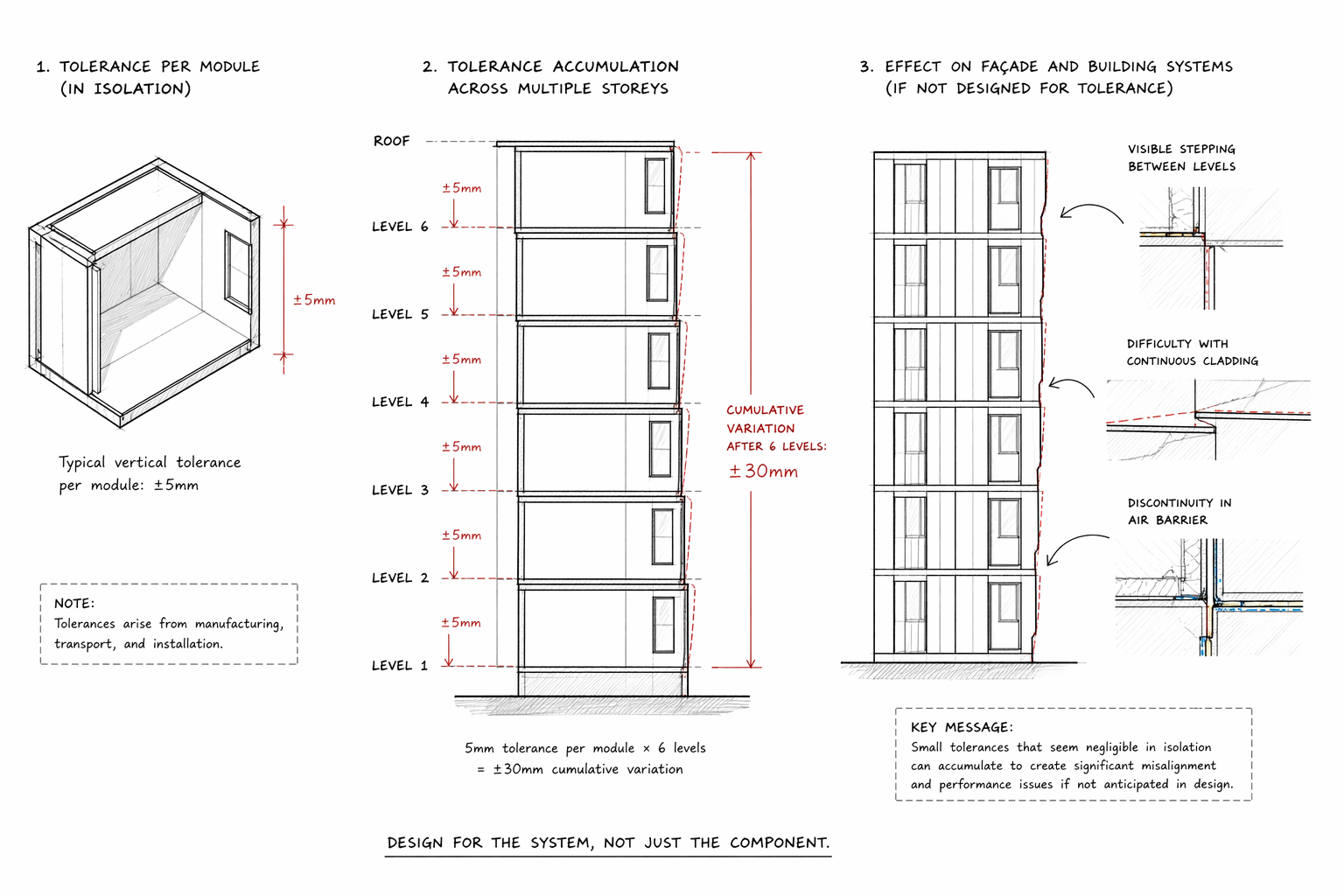
Consider a mid-rise modular building in which each module has a vertical tolerance of approximately five millimetres. While this deviation may appear negligible in isolation, it becomes significant when multiplied across multiple storeys. Over six levels, the cumulative variation could approach thirty millimetres.
If façade systems are designed with minimal tolerance, this misalignment can manifest as visible stepping between levels, difficulty in installing continuous cladding systems, and discontinuities in air barrier assemblies. These issues are not the result of poor fabrication, but of a failure to anticipate how small tolerances accumulate across the building.
This scenario illustrates the importance of designing not only for individual components, but for the behaviour of the system as a whole.
Key Takeaways
Modular construction requires a shift from designing for flexibility to designing for controlled precision. Tolerances are inherent to both manufacturing and construction processes, and their effects are amplified in modular systems through accumulation and interface conditions. Successful modular design balances rigorous dimensional coordination with carefully defined zones of adjustment, while also accounting for transport and lifting constraints from the earliest stages of the project.
•••
XLBench is your go-to platform for modular construction insights, setting industry benchmarks, fostering expert discussions, and sharing the latest trends. Through Benchboard, we provide data-driven research, thought leadership, and in-depth analysis to advance modular innovation.
Stay informed and be part of the conversation—follow XLBench for the latest updates, expert insights, and industry trends.
•••
xL Architecture & Modular Design (XLA) is an innovative architecture firm redefining the future of building through off-site construction technologies. With expertise in volumetric modular designs, and panelized building systems, we create cutting-edge solutions that seamlessly integrate form, function, and sustainability.